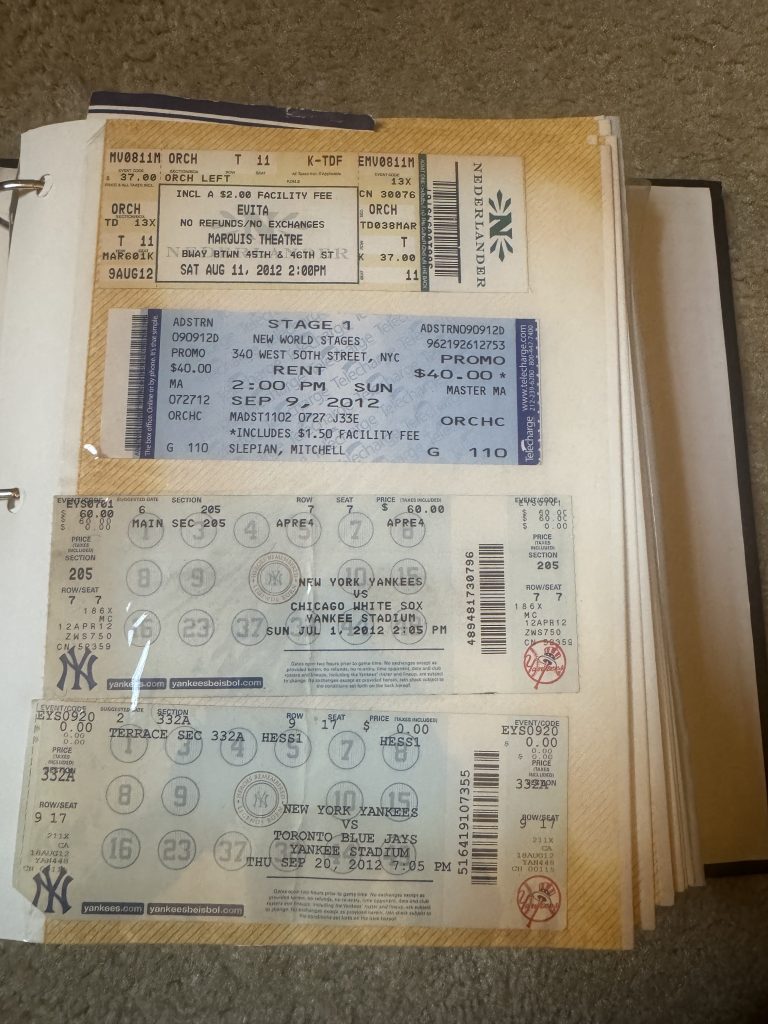
I Got a Ticket. Not a Ticket to Ride.

Paper Tickets

The other day, I got a ticket. No, it wasn’t a speeding or parking ticket. Or one for not properly placing my trash cans at the curb. I don’t have to do that. I have the joy of an incinerator. I visit it many times a day. My grandfather would be proud. I did not get a ticket to ride.

I was at Lincoln Center for a photo shoot with my wide-angle lens. Before shooting, I went to the Metropolitan Opera House and bought a ticket for “Tosca.” I went to Vivian Beaumont Theater and purchased tickets for “A Few Good Men.” I finished my shopping by entering David Geffen Hall and renewing my New York Philharmonic subscription. I will be attending several concerts.

At David Geffen Hall, the ticket clerk looked up my email address (they did that at the opera house, too) and asked me what shows I wanted. I picked a few and tapped my iPhone to pay. I said, will my tickets be in my account? He said, yes or do you want paper tickets? I thought for a minute and asked which is better. Mind you, I have been a subscriber for about a decade and always had electronic tickets. You know, you download them, save them in your Apple Wallet, and scan them in at the theater.

Lincoln Center Theaters and Revson Fountain

He then said, “It does not make a difference. Do you like electronic things, or do you prefer paper?” I love electronic stuff. I said, paper. He printed them and stuffed them into an envelope. Keep in mind, at Beaumont and the opera house, they handed me paper tickets immediately. I didn’t get a choice. 

As I was thinking about my e v. paper tickets. I was blasted back to the old days. Remember when we used to call Ticketmaster and wait on hold for what seemed like hours for tickets for The Cure, Depeche Mode, Yankee-Red Sox games, and U2? Sure, you do. Eventually you spoke to an agent, gave them your credit card number, and were told they’d mail your tickets. Of course, there was a fee for that – Standard postage or more for FedEx. For Broadway theater, I often went to the box office and got paper tickets. 

Then the day came when you walked into the Garden, the Stadium, or the Nederlander. The person at the door tore your ticket, gave you the stub, and you went to your seat. You waited and hopefully made it to the top of the ninth with the Yankees ahead, heard “Enter Sandman,” watched Mariano save the game, and walked to the subway to “New York, New York.” Or you saw Robert Smith come out and sit in the dark while he played for nearly three hours. Fun times. 

We are still doing that. But now they scan your phone, and you hope it works. The other day for a Yankees-Red Sox game, I had to scan the ticket many times until I got in. I did. We lost. I was back the next day; we won 16-1. The day we lost, I headed to Radio City Music Hall after the game, scanned my ticket, and suddenly, I was “Up the Junction”—in other words, I saw Squeeze.

To me, it doesn’t matter how I enter the venue. I just wanna be in. But I must admit there is something magical about the paper ticket. I always keep them. I have journals with tickets from my first Yankee games back in the day when number 1, Billy Martin, was managing, and from seeing The Cure in the 80s. And of course, “Rent” with the original cast.

There was something special about looking at that ticket. When I look at them in my Apple Wallet, it is not as special. I am just happy the transfer from AXS or Ticketmaster processed. 

Talk to ‘ya after “Tosca.”

How Much Harder Is It to Communicate in Today’s World?

By Mitchell Slepian

In today’s world, we have so many tools to communicate with each other. Does it make life easier? Yes. Does it make life tougher? Yes. Let’s sit back and think for a minute. We now communicate in person, by phone, text, chat, social media, and other ways. It’s not unusual to be sitting at your desk, whether it is in your kitchen or an office somewhere in the city, focusing on your assignment, as emails fly across your screen, your phone buzzes with countless texts, and people are contacting you on Facebook’s and LinkedIn’s messaging services. Does it make it easier? It can. Does it make it rougher? It can.

Many people get jittery as they enter the final stages of a project. As you’re launching it on your website, social media feeds, and to the media, you want it to be perfect. Once it’s been decided that the documents, graphics, etc., are final, the push begins. As you’re uploading to your project management software to start the distribution process, it’s often when it can get chaotic.

I like to remain focused, sit at my laptop, plug away, and be zoned in only on the project at hand.  Too many times, it’s at that time when everyone decides to weigh in once again. My Outlook account is full of emails. Thanks to today’s technology, you can see them jumping out at you. My phone goes crazy with countless texts. Then there are the people who decide to message you on LinkedIn or Facebook. Or use Slack or Snap. Does this help you? Yes and No. But in many cases, that’s what creates confusion and leads to mistakes. I have been telling people at the final stages of the project, let’s use one stage of communication. I prefer email. I make sure to tell people to remember to hit reply all. Most of the time, this works. It keeps people focused.

Does Constantly Checking Your Email Give You Peace of Mind?

Or Does it Drive You Crazy?

By Mitchell Slepian

I remember back in the day, when you couldn’t check your email on your phone or by logging in on another computer. You had to check it on the computer you normally used. Years ago, my sister and I shared an email address. I figured out how to check it from other computers. I would log on and email her. She got a little nervous and scared. She had no idea how I was doing this. Of course, I explained everything. But I had fun for a day or two.

I remember when I was at a PR firm and on a Friday, booked the CEO (Scott D. Cook) of the company I was representing (Intuit) onto CNBC. He was supposed to be on the following Monday. I was in NYC, and Cook was in Mountain View, Calif. The producers were working out the final details. They, a coworker, and I left each other voicemails all weekend. We were checking nonstop. Monday came around, and we worked everything out with Cook’s executive assistant and he did a great interview.

These days, all we would have to do is send a few emails or texts, and everything would be set. In some jobs, you need to constantly check your email. But the question I would like to raise is: how much checking is too much? Do you check immediately before going to bed and as soon as you wake up? Does it kill when you need to turn your phone off during Broadway shows, the New York Philharmonic, and operas? When is checking excessive? Can you sit through dinner with family and friends without logging on?

The best part is that most of the time, all your emails come from your project management applications, such as Basecamp or monday.com, letting you know the web update is live or that edits have been made to a document. Oh, and there are sales pitches for things your company will never need. Or people reaching out to you to forward their resumes to HR. These people are not people you know. They are just spamming everyone they can secure an email address for. 

For the record, before I sat down to write this, I was at the gym. My workday was over. I was doing some core work and checked my email. On the super-long train ride into work that morning (due to a stalled train at a major station), I held back from checking and kept reading “Remain in Light” by Chris Frantz. I tried my best to stick with the book on my Kindle and not try to live that wildlife by checking my office’s email.  I even skipped checking my personal email accounts. I have too many of those.

Bottom line, I think it’s fine to check it in moderation. But I always remember that the email you’re waiting for, or think is coming will probably come in due time.

What’s the Best Way to Communicate: email, social media or texting?

By Mitchell Slepian

Email has been mainstream in business since the 1990s. As we know, we now have too many other ways to communicate, including but not limited to social media and texting. Remember faxing? Or snail mail? Both are still in play. 

As a chair of a community organization and a volunteer in a few others, we generally communicate our business via email. Several of us who are friends often have our own discussions via chat. But all official business is done via email. 

We have members who do not have email. They do not have computers. Some are senior citizens. But before we toss in the age factor, I have worked with people in their early 90s to create PowerPoints and run podcasts. They had no issues. Yes, I worked with people much younger who had no clue how to use email or other communication methods. So, age is just a number.

About two weeks ago, it snowed in New York City. It hampered some events. One started at 7:30 a.m.  ET. The other was supposed to begin at 9 a.m. ET. We wound up combining our groups. This recent storm was not the first time we have had to take that course of action. It will not be the last. We early birds sat around, and the folks from the later-starting group wandered in. Both groups have their latecomers. Snow delayed some of them even further. A day or two later, I suggested that when we know the weather will not be good, we send an email and make a robocall to let people know we are combining. Several people blasted this idea, saying some people don’t have email, and others don’t want to be bothered by a robocall. I made the case that email has been in play for a long time and that the call was coming from a number we all know. It should not register as a potential spam call, as carriers like to say.

I know people who text to landlines. I still have one. The texts usually arrive in gibberish. As chair of my group, generally start meetings (which are traditionally on Zoom, that’s another issue), reminding people you need to text their cell phones. Some folks love Facebook Messenger. Unfortunately, they do not realize Messenger works on Facebook. Many don’t know that you cannot email Gmail or send SMS messages from Messenger. Don’t get me started on WhatsApp. I think it works great and has its place.

Before I was chair, I was corresponding secretary. I created a form for people to send me via email when they donate. I can take their contact information off it and generate thank-you notes to distribute via email and traditional mail. It is still lovely to receive a personal, warm thank-you note in the mail. One of my chairs used to mail me handwritten notes with donor information. Sometimes he would wait weeks, and I’d get an envelope with 30 or 40 scraps of paper with contact information. This issue severely hampered our program.

The question has always lingered in my mind: What to do? I continue to use email and will call people. But the question will always linger on how to reach everyone.

The Annoying Things PR Pros Get Stuck With

Think Them Through and Realize How Important They Are

By Mitchell Slepian

Every job has its exciting stuff. Every job has its why am I stuck with this? Sometimes, the latter is what grows your metrics and ultimately your organization’s revenue or reputation. I am sure Hall of Famers like Derek Jeter and Mariano Rivera found specific training or other drills annoying. But they did it, and they have five rings to show for it. I wish they had more.

Back to the real world. We all love it when we score a hit on Dow Jones Newswires, a key industry trade, or when your Instagram and LinkedIn posts are hitting record views and have positive comments. Then there is managing the communication team’s email box. We all know that’s the overloaded inbox with requests from reporters, analysts, and event producers who want your CEO and CFO to speak at a leading industry event. We jump on those. Then there are the customer emails complaining. In your mind, you wonder, why didn’t they contact customer care? Maybe they did. Perhaps they never heard back or weren’t pleased with the service.

We get emails from people asking you to buy batteries, hamburger patties, insurance, or to see if they are related to you, and wonder what discounts you can give them. I am sure you’ve received the queries from people whose parents or grandparents worked for or were involved with your organization. Maybe they contributed money for fundraising campaigns or held leadership roles.

When I was in the internet telephony world, people emailed the PR Team’s mailbox every day. Rarely was it a reporter. They knew how to find us. One guy called me and tried to get me to buy his battery backup system. He said that if our network went down, his company would save us, and he was the only one who could. I directed him to our website, which explained our procedures for network outages. They had to be on our site. People purchasing our service needed to know the system worked. He said he never checked our site. I remember saying something along the lines that you probably should research the company you’re asking to spend six figures on before cold calling. He hung up.

I often get emails or calls from people whose now-deceased grandparents made donations to the organizations I volunteer for or work for. They want to know whether the plaques with their names are still hanging or whether the rooms dedicated in their honor are still in use. Often, they tell their children about the nice things their family did. 

Many of us do not consider this public relations. But it is. When you take the time to listen to these people or work with those at your company or volunteer organization to get them the answers they need, it goes a long way.  They are happy and will write positive comments on your social media feeds, buy more of your products, make donations, and come to events. Sometimes the annoying things are what help you grow.